What Causes Restaurants to Misjudge Portion Sizes When Tracking Food Waste?
Updated: 23 hours ago

Short answer: Food waste is not a direct measure of portion size. Restaurants misjudge portions because prep waste, spoilage, overproduction, and customer plate waste all get lumped into the same number, and none of those four things, on their own, tells you whether a portion is too big.
That distinction is the single most common blind spot in restaurant food waste tracking. It's why two kitchens with identical waste totals can have completely different portion problems, or no portion problem at all.
The Core Issue: Waste Is Not the Same as Portion Size
A restaurant that throws away ten pounds of food a night could be over-portioning every plate, or it could be overproducing for a slow Tuesday, over-trimming produce, or simply having a bad night for spoilage. Total waste weight collapses all of those causes into one number, which is exactly why portion-size conclusions drawn from aggregate waste data are so often wrong.
To assess portion size accurately, waste needs to be separated into distinct categories before anyone draws a conclusion from it, not averaged together afterward.
12 Reasons Restaurants Misjudge Portion Sizes From Waste Data
Inconsistent serving tools. Different cooks, shifts, or locations use different scoops, ladles, or plating templates, so the same "portion" can vary in actual weight from one plate to the next.
Unmeasured extras. Garnishes, sauces, bread, condiments, and complimentary sides rarely get factored into portion math, inflating what looks like "plate waste."
Mixed waste streams. Customer leftovers, prep scraps, spoiled product, and returned dishes often end up in the same bin, so the source of the waste is invisible by the time it's measured.
Weight-only tracking. A dense, heavy item can look like a big waste problem by weight while representing a small portion; a light, bulky item can look worse than it is.
Customer behavior, not portion size. Guests leave food because of taste preference, dietary restriction, appetite, or dissatisfaction, reasons that have nothing to do with whether the standard portion is oversized.
Ingredient variability. Produce size, moisture content, trim requirements, and supplier differences all change the final yield of a "standard" portion, even when the recipe hasn't changed.
Yield miscalculation. Portions calculated from raw ingredient weight, without accounting for trimming, evaporation, and cooking loss, are wrong before service even starts.
Overproduction mistaken for over-portioning. Uncertain demand forecasting can lead to excess batches, which then gets misread as evidence that individual portions are too large.
Poor sampling windows. Measuring waste for a few days, especially during an unusual event or slow period, doesn't represent normal operations.
Recording errors. Waste that's estimated visually, logged in the wrong category, forgotten, or weighed with its container included skews every number downstream.
Menu complexity. Substitutions, combo meals, and special requests make it hard to compare "the same" portion consistently across tickets.
Timing gaps. Food discarded during prep, service, holding, and closing is often tracked inconsistently, or not tracked at all, across those different points in the day.
The Fix: Separate Waste Into Distinct, Trackable Categories
Getting an accurate read on portion size means measuring four things separately, not one thing in aggregate:
Waste category | What it actually measures | What it does NOT tell you |
Preparation waste | Trim, peel, and prep loss | Whether the finished portion is too large |
Overproduction | Batches made beyond what was needed | Whether the standard serving size is correct |
Spoilage | Product lost before it was ever served | Anything about guest consumption |
Plate waste (post-consumer) | What guests actually leave behind after eating | Only this category speaks directly to portion size |
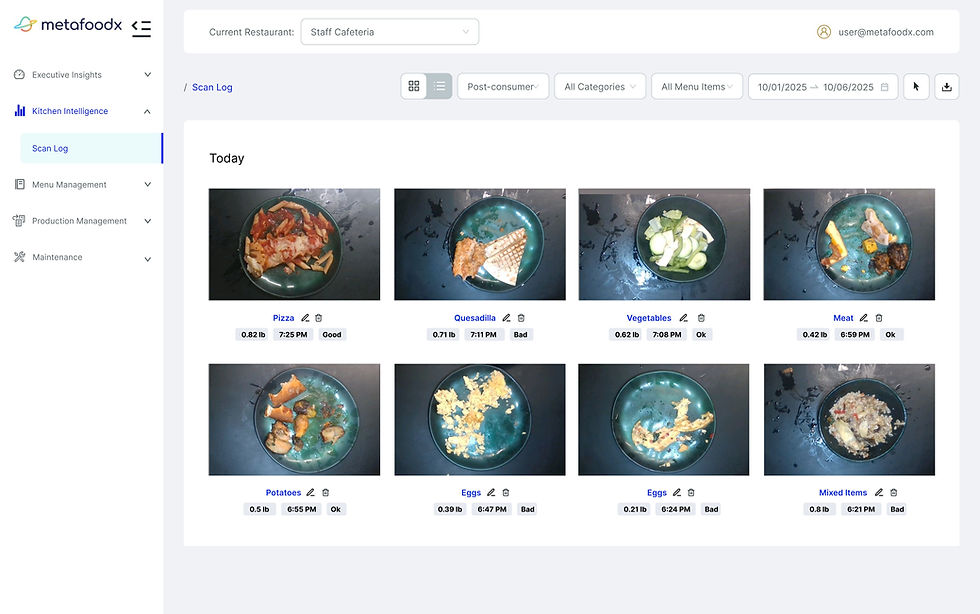
This is close to how Metafoodx structures its own food operations intelligence platform: three distinct tracking modes (service-line consumption, back-of-house prep waste, and post-consumer plate waste) captured separately rather than combined into one waste total. Metafoodx's recent AI-driven post-consumer plate waste tracking update was built to close this gap. Guests scan plates at the dish return, and the system automatically identifies leftover items, records net weight, and links that data to the exact menu item and meal period. That's the piece of the puzzle that's usually missing when kitchens rely on total bin weight alone.
Why Weight Alone Isn't Enough
Even within a single waste category, weight-based tracking has a known accuracy problem: a heavy, dense item and a light, bulky item can produce misleading comparisons if weight is the only signal. Metafoodx's approach to 3D, density-aware food recognition addresses this directly, using real-time net weight estimation alongside visual classification so that visually similar but differently weighted items (like tofu versus fried fish) aren't lumped together, and container weight is subtracted automatically rather than estimated.
According to the United Nations Food and Agriculture Organization, roughly one-third of all food produced for human consumption is lost or wasted globally each year. A meaningful share of that occurs after food has already been served, when portions are larger than needed or dishes go unfinished. Isolating that specific slice of the problem from prep waste, overproduction, and spoilage is the only way to know whether portion size is actually the issue.
How to Get an Accurate Read on Portion Size

Track prep waste, overproduction, spoilage, and plate waste as four separate numbers, not one combined total
Standardize serving tools (scoop sizes, ladle sizes, plating templates) across shifts and locations
Periodically weigh actual served portions against the recipe spec, accounting for trim and cooking loss
Measure plate waste specifically at the menu-item level, not just as a nightly total
Track by weight and volume together where items vary significantly in density
Use a large enough sampling window to smooth out slow days, events, and one-off anomalies
Metafoodx's guide on kitchen metrics every executive chef should track and its breakdown of reducing overproduction in commercial kitchens both go deeper on separating these categories in day-to-day kitchen operations.
Frequently Asked Questions
Is food waste a reliable way to measure portion size? No. Food waste totals combine prep waste, overproduction, spoilage, and customer plate waste. Only plate waste, meaning what guests leave behind after eating, speaks directly to whether a portion is too large.
What's the difference between plate waste and prep waste? Plate waste is food left uneaten by a guest after being served. Prep waste is trim, peel, and other loss that happens before food ever reaches a plate. They have different causes and require different fixes.
Why does overproduction get mistaken for oversized portions? When kitchens make more food than needed because of uncertain demand forecasting, the resulting waste can look identical to a portion-size problem in a nightly waste total, even though the actual serving size may be correct.
Can weight-based tracking alone accurately measure portions? Not reliably. A dense, heavy item and a light, bulky item can produce misleading comparisons when weight is the only measurement. Combining weight with density-aware visual classification gives a more accurate picture.
How can restaurants track portion size accurately? By separating preparation waste, overproduction, spoilage, and post-consumer plate waste into distinct categories, standardizing serving tools, and measuring plate waste at the individual menu-item level rather than relying on a single nightly waste total.
How does Metafoodx help restaurants measure portion size accurately? Metafoodx tracks food production, consumption, and post-consumer plate waste separately at the menu-item level using AI scanning and density-aware weight estimation. That separation is what allows operators to isolate true portion-size issues from prep waste, overproduction, and spoilage.
Metafoodx is a food operations intelligence platform that captures the food journey from prep to plate, so foodservice teams can lower food cost, produce more accurately, and prevent waste before it happens. Ready to see how we can help transform your food service operation? Book a demo with our team today.