
California SB 1383: A Foodservice Operator's Guide to Compliance
Updated: 3 days ago
A practical guide for higher education, hospitality, corporate dining, and commercial kitchens
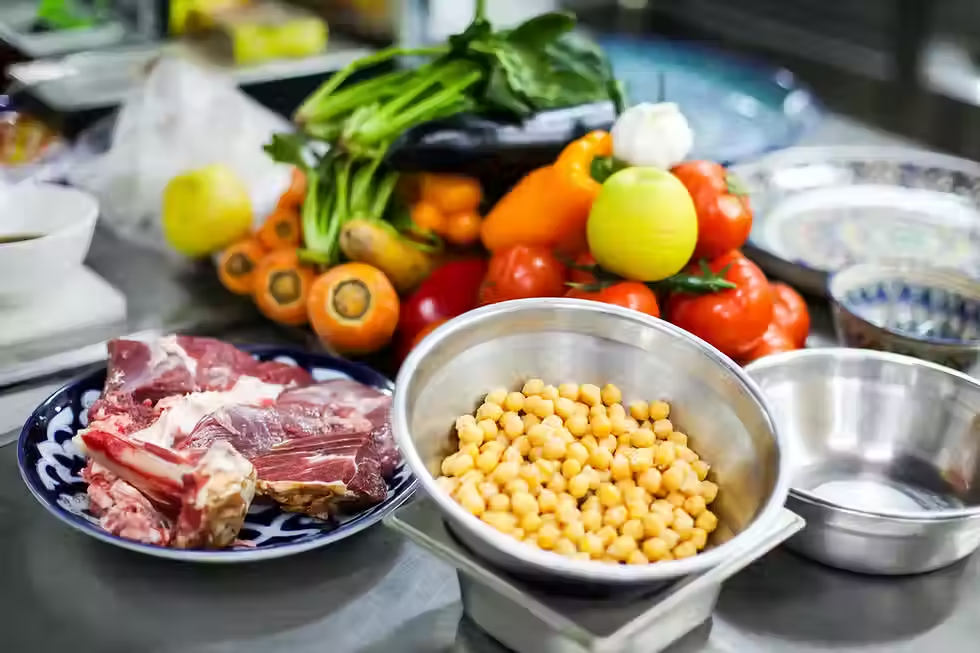
California's SB 1383 requires many foodservice businesses to recover edible surplus food, divert organic waste from landfills, and keep records that prove compliance. For colleges and universities, hotels, corporate dining programs, and other commercial kitchens, the law is about more than checking a regulatory box. It's also a chance to cut food waste, tighten production planning, and run a more efficient kitchen.
Below, we break down what SB 1383 requires, who it applies to, and how Metafoodx's AI-powered kitchen intelligence platform helps operators meet those requirements while reducing food costs.
What Is California SB 1383?
SB 1383, formally the Short-Lived Climate Pollutant Reduction Strategy, is a state law aimed at cutting methane emissions by diverting organic waste from landfills and increasing edible food recovery. It sets two statewide goals:
Reduce organic waste disposal by 75%
Recover 20% of edible food that would otherwise be thrown away, and redirect it to people in need
To reach those goals, covered food businesses must recover edible surplus food, separate organic waste, and document their food recovery activities. The California Department of Resources Recycling and Recovery (CalRecycle) administers the program at the state level, while local jurisdictions handle inspections and enforcement.
Who Has to Comply? Tier 1 and Tier 2 Generators
SB 1383's edible food recovery rules apply to specific categories of "commercial edible food generators," split into two tiers with different start dates:
Tier 1 generators (compliance required since January 1, 2022):
Supermarkets and grocery stores over 10,000 square feet
Food distributors and wholesale food vendors
Large food service providers and large event venues
Tier 2 generators (compliance required since January 1, 2024):
Restaurants larger than 5,000 square feet or with 250+ seats
Hotels with an onsite food facility and 200+ rooms
Health facilities with an onsite food facility and 100+ beds
State agencies and local education agencies with cafeterias
Local jurisdictions determine exactly which businesses in their area are covered and are responsible for inspections and enforcement, so operators should confirm their specific tier and deadlines with their local agency.
What Does SB 1383 Require?
Requirements vary somewhat by business type, but covered foodservice operators are generally expected to:
Recover edible surplus food through approved food recovery organizations or services
Maintain signed agreements with those food recovery organizations
Keep records of donations, recovery activities, and any documentation requested during inspections
Separate and properly manage organic waste that can't be donated
One common misconception: SB 1383 does not require every business to donate exactly 20% of its food. The 20% figure is a statewide recovery target, not an individual mandate. Covered businesses are expected to recover as much edible surplus food as reasonably possible, not hit a fixed percentage.
Why Many Kitchens Struggle With Compliance
Most commercial kitchens can tell you how much food they purchased and how many meals they served. What they usually can't tell you is what happened at the menu-item level: what guests actually consumed versus what was thrown away.
Without that visibility, it's hard to answer basic questions:
Which menu items are consistently overproduced?
How much edible food could realistically have been donated?
Which kitchens or shifts generate the most surplus?
Is production forecasting actually improving over time?
Without objective, menu-level data, production decisions end up based on experience and gut feel rather than measurable consumption, which makes both waste reduction and SB 1383 recordkeeping harder than they need to be. Metafoodx's 7 kitchen metrics every executive chef should track breaks down the specific numbers that close this visibility gap.
Better Data Leads to Less Waste and Easier Compliance
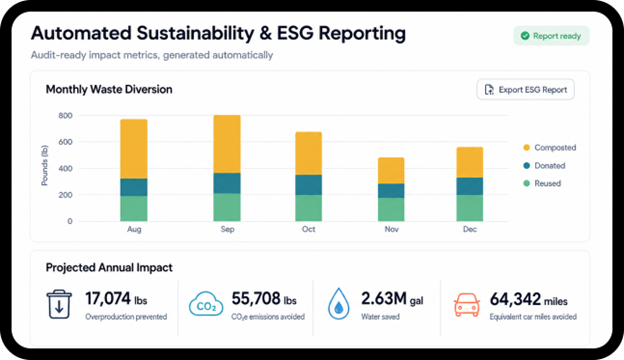
Food donation is an important part of SB 1383, but preventing unnecessary production in the first place has an even bigger impact on both cost and compliance.
Every pan of food that never needed to be prepared represents unnecessary purchasing, labor, utilities, and production cost. Understanding actual menu-item consumption lets chefs and dining managers improve forecasting, reduce overproduction, maintain service quality, and build more intentional food recovery programs. See Metafoodx's guide on how to reduce overproduction in commercial kitchens for specific tactics.
A growing number of organizations are turning to AI-powered kitchen intelligence to automatically measure production, consumption, leftovers, and surplus food instead of relying on estimates. For multi-location operators, such as a hotel group with several properties or a university with multiple dining halls, consistent data also makes it easier to compare kitchens, spot best practices, and improve forecasting organization-wide.
What technology helps foodservice operators comply with California SB 1383?
SB 1383 asks covered businesses to recover edible surplus food and keep records of it, including the recovery organizations they work with and the types and pounds of food donated each month. Technology helps by logging surplus by item and weight when it happens, recording where it went, and producing reports for inspectors. It also shows which dishes are overproduced, so there is less surplus to begin with.
What to look for in SB 1383 compliance technology:
Automatic surplus logs: item, weight and date captured at the time, not reconstructed at month end.
Destination tracking: donation, reuse, composting or disposal recorded for each item.
Inspector-ready reports: monthly totals by food type that match your recovery agreements.
Prevention data: production versus consumption by menu item, so overproduction drops over time.
See also our guide to US food waste laws by state.
How Metafoodx Supports SB 1383 Compliance
Metafoodx helps commercial kitchens understand exactly what happens to every menu item after it's produced.

Staff scan food before it goes to the serving line and scan leftovers only when they return from service. If a pan comes back empty, there's nothing to scan. Using AI food recognition, weight sensing, and temperature monitoring, Metafoodx automatically tracks:
Food produced
Food consumed
Overproduction
Leftovers
Surplus food destinations: donation, reuse, composting, or disposal
Temperature logs, for food safety documentation
Instead of relying on estimates, operators get objective production-versus-consumption data for every menu item, exactly the kind of recordkeeping SB 1383 inspections ask for. That data also feeds directly into better forecasting, food recovery planning, and sustainability reporting. Metafoodx's kitchen intelligence software overview covers how this works across different foodservice settings.
By Industry
Higher education: College and university dining halls face high-volume, high-variety production across multiple daily meal periods. See how universities are reducing waste and optimizing food costs with menu-level consumption tracking.
Hospitality: Hotels with onsite food facilities above the Tier 2 threshold need to track both banquet/event production and daily restaurant service separately.
Corporate dining: Contract foodservice operators managing multiple client sites benefit from standardized, comparable data across locations.
Looking Beyond Compliance
SB 1383 is about more than meeting a regulatory requirement. It encourages foodservice operators to reduce waste through better production planning and food recovery, which is also good business. Organizations with accurate menu-level data are better positioned to improve forecasting, reduce overproduction, lower food costs, and support sustainability goals. As more states and institutions adopt similar food waste policies, kitchens with real operational visibility will be ready to meet future requirements while running more efficiently today.
Frequently Asked Questions About California SB 1383
Does SB 1383 apply to every restaurant? No. SB 1383's edible food recovery requirements apply to specific categories of Tier 1 and Tier 2 generators, generally larger commercial food businesses. Local jurisdictions determine which businesses in their area are covered.
Is every business required to donate 20% of its food? No. The 20% edible food recovery figure is a statewide goal, not an individual requirement. Businesses are expected to recover the maximum amount of edible surplus food they can reasonably donate.
What counts as a Tier 1 or Tier 2 generator? Tier 1 includes large grocery stores, food distributors, wholesalers, and large event venues. Tier 2 includes restaurants over 5,000 square feet or 250+ seats, hotels with 200+ rooms and an onsite food facility, health facilities with 100+ beds, and similar mid-to-large operations. Check with your local jurisdiction to confirm your specific classification.
What records should foodservice operators keep? Covered businesses should maintain signed food recovery agreements, donation records, collection schedules, and any other documentation their local jurisdiction requires.
What counts as edible surplus food? Edible surplus food is food that's safe for human consumption but no longer intended for sale or service. It can be donated to an approved food recovery organization instead of being discarded.
How can kitchens reduce food waste before it needs to be donated? The most effective strategy is improving production forecasting. Understanding actual menu-item consumption helps kitchens prepare closer to demand, cutting unnecessary overproduction while maintaining service quality. Metafoodx's guide on reducing overproduction in kitchens walks through specific strategies.
How does Metafoodx help with SB 1383? Metafoodx provides AI-powered kitchen intelligence that tracks production, consumption, overproduction, leftovers, surplus food destinations, and temperature logs. That objective, menu-level data helps operators reduce food waste, improve forecasting, identify food recovery opportunities, and support SB 1383 recordkeeping and sustainability reporting.
Explore more on the Metafoodx blog, or book a demo to see how menu-level kitchen intelligence supports SB 1383 compliance in your operation.
Related reading: US Food Waste Laws by State · Foodservice Compliance in 2026
Metafoodx is an AI-powered food intelligence platform that helps foodservice operations reduce waste, cut costs, and improve kitchen efficiency. Ready to see how we can help transform your food service operation? Book a demo with our team today.


